
September 2026 Newsletter: Celebrating a PFAS Victory
Hello!
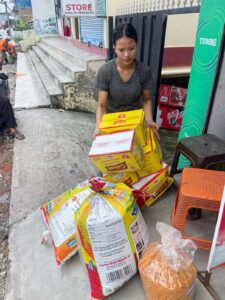 How to help in Nepal I hope you’re enjoying the end of summer. I have recently returned from our Senior Fellows retreat in beautiful Inverness in Northern California. Read on below about the innovations and progress the Fellows have made this year. In case you’d like to help the people of Nepal recover after the recent catastrophic flash flooding, two effective small on-the-ground organizations that I support are We Help Nepal and Read Global. On a happier note, I’d like to celebrate an update we’ve made to our PFAS-Free list on PFAS Central. Thanks to new state laws banning PFAS in a variety of consumer products, many items including outdoor gear, apparel, shoes, personal care products, 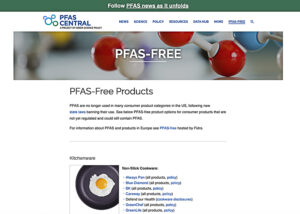 Check out our PFAS-Free list It took years of research from scientists, pressure from NGOs, and the voices of community members to encourage lawmakers and manufacturers to stop the use of these harmful forever chemicals. We applaud the persistence and partnership leading A few consumer product categories still need further scrutiny. Non-stick cookware and small kitchen appliances, some home maintenance products like sealants and fire suppressants, and contact lenses can still contain PFAS. In further positive news, we contributed to CNN telling the story of how quaternary ammonium compounds (QACs) were linked to birth defects and reproductive failure in mice, after a Washington State University traced unexplained health problems in its lab animals back to the disinfectant used on their cages. A follow-up article asked a simpler question: when do you actually need to disinfect your home? The answer: far less often than people think. Though a lot of the QAC evidence so far comes from animal studies, more human evidence is emerging. A new pilot study published last month found QACs in over 99% of meconium samples from 74 mother-infant pairs in New York City. Higher cumulative QAC exposure was linked to lower birthweight, and teachers had the highest exposure levels—possibly from antimicrobial wipes with QACs included in Back-to-School lists as discussed below. There has been activity on flame retardants too. The EPA is revisiting the safety of TBBPA, found in roughly 70% of electronics worldwide and in household dust, clothing, and carpeting. “It can get into humans and contribute to cancer and behavioral harm. Infants and toddlers who crawl in the dust and put their hands in their mouths are especially vulnerable,” I told The Guardian. Despite this, the EPA’s draft risk assessment concluded TBBPA isn’t carcinogenic at typical US exposure levels, a conclusion European regulators and international cancer agencies don’t share. Former EPA scientist Maria Doa says the agency relied heavily on industry-funded studies to reach that conclusion, including from a firm whose founder now sits on the EPA’s own science review committee. We hope impartial science can prevail as this EPA assessment moves toward a final decision.  Here is information on where and how you can vote With the critical midterm election coming, please remember that voting can shape environmental health policy. Please consider volunteering with or donating to one or more of the worthy organizations that are registering and encouraging voters in critical regions such as Seed the Vote, Walk the Walk USA, Focus for Democracy, Black Voters Matter, Native American Voting Rights, Asian Americans Advancing Justice, and Voto Latino. Please make a voting plan to vote early if possible and encourage others to do the same. Finally, if you, or someone you know, is a problem solver with administrative experience who would like a paid position helping me with a variety of tasks a few evenings a month in person in Berkeley CA, please email me. Also my small in-law studio in the Berkeley hills (with a rugged path to its entrance) will be available to rent in October, so let me know if you or someone you know is looking. Arlene and the Green Science Policy Institute team P.S. This December, I am planning an easy trek in the Annapurna range of Nepal and exploration of the magical Kathmandu Valley. If you’d like more information about possibly joining my Himalayan adventure, get in touch. |
Senior Fellows UpdateOur Senior Fellows gathered for a retreat this month in Inverness, and each is making Lauren Heine is making good progress in developing the “Detoxifying Plastics Protocol”, a standard to certify plastics containing reduced harmful chemicals—really important for our health and the safe recycling of plastics. Lauren is sharpening the business case for this practical testing approach which allows manufacturers, suppliers, and purchasers to verify that plastic is free of hazardous additives from 12 chemical and functional classes. Meredith Williams has written policy summaries for ten California bills that could strengthen the state’s protections against toxic chemicals, vetting each brief with subject matter experts so advocates have ready-to-use options. At the retreat, she also began sketching a framework for tracking progress on reducing harmful chemical use, borrowing lessons from how the climate movement built its own targets and metrics. Susan Kegley is investigating possible links between newer pesticides and ongoing honeybee colony losses, working with collaborators in Europe and Canada to understand colony loss patterns and contributing to strategic planning with the Pollinator Stewardship Council. She’s increasingly focused on regenerative agriculture as an alternative that could address the underlying causes of both pesticide overuse and pollinator decline. Joel Tickner is developing a 30-year roadmap for a safer, more sustainable chemical industry. Over the past 15 months, he’s built alliances with European climate and toxic prevention groups, developed a policy framework to incentivize safer chemistry and organized a workshop with the Science History Institute. Next, he plans to publish a 20- year review of safer chemistry efforts and convene industry leaders to help set shared goals for the field. |
Safer Sofas for Ireland and Hopefully the UKLast month Ireland announced it’s updating its 30-year-old furniture flammability standard so that flame retardants will no longer be needed. Furnishings, people, and the environment in Ireland should be healthier as a result.  Healthier furniture means healthier people The UK is considering a similar update that would also remove the need for flame retardants in UK furniture. See this front page story from the Sunday London Times with the dramatic story. Ireland and the UK are the only countries that still require flame retardants in upholstered furniture. Our Institute has been supporting both in moving away from this unnecessary use of harmful chemicals, just as we helped update California’s standard so flame retardants are no longer needed in US furniture. California’s State Fire Marshal wrote the UK government noting that average furniture related fire deaths decreased by 31% after California changed its standard away from flame retardants. The benefits of the new standard for both health and fire safety provides a strong contrast to past flame retardant industry claims that stopping the use of flame retardants in furniture would greatly increase fire deaths. The Fire Marshal wrote: And even more encouragement comes from a recent California Department of Public Health study that we helped initiate, which found that replacing flame retardant furniture cut levels of the harmful flame retardant pentaBDE by half in resident’s bodies in just 15 months. That reduction matters, as numerous epidemiological studies found that U.S. children have lost an average of four IQ points from exposure to pentaBDE, and people with the highest levels were 300% more likely to die of cancer than those with lower levels. You can learn more on our website, an excellent article in The Guardian, and the memorable documentary “Toxic Hot Seat.” which is now available for free on YouTube. |
Harmful Antimicrobial Products on Back-to-School ListsBy Rebecca Fuoco If you have a child heading back to school, check their supply list.  Don’t send harmful and unnecessary antimicrobial products to school Don’t be surprised if you see disinfecting wipes and/or antibacterial hand soap. Most disinfecting wipes use quaternary ammonium compounds (QACs), which are US EPA registered pesticides and warn against children exposure. QACs have been linked to respiratory and skin harms in humans, as well as reproductive, developmental, and neurological harms in animal studies. They can also contribute to antimicrobial resistance. They don’t belong on school supply lists, and state health departments agree. For example, Vermont’s Department of Health issued guidance against adding disinfecting wipes to school supply lists, warning that disinfecting wipes are “unsafe for classroom use.” The Washington State Department of Health’s school supply list guidance advises against disinfecting wipes, instead recommending fragrance-free Disinfection does have a legitimate but narrow role in schools, including cleaning areas contaminated by bodily fluids and meeting certain health-code requirements. Those jobs should be handled with appropriate products and protections by trained custodial staff and not by children or even teachers. Antibacterial hand soap also doesn’t belong on these lists. In addition to health concerns about their ingredients (which are either QACs or chloroxylenol), there is consensus among the FDA, CDC, and WHO that they have no benefit over plain soap for community settings. The American Academy of Pediatrics advises that children should use plain soap rather than antibacterial soap. As such, Washington State says schools should use plain, non-antibacterial soaps. If your child’s list contains disinfecting wipes or antibacterial hand soap, consider emailing this blurb (including hyperlinks) to the principal. |
More Flame Retardants, Less Safety?By Anna Soehl Last month we and others submitted comments to the Consumer Product Safety Commission (CPSC) on a proposed national safety standard for lithium-ion batteries in e-bikes and other micromobility products. We urged the Commission to remove a provision leading to the unnecessary use of flame retardants in plastic battery enclosures. As we summarized it in our ES&T viewpoint while the health harm of flame retardants is well documented, the fire safety benefit of adding flame retardants to plastic cases around lithium-ion batteries is unproven and unlikely. As Dr. Vyto Babrauskas, considered the father of fire science said: “Trying to stop thermal runaway fires by adding flame retardants to plastic is like adding 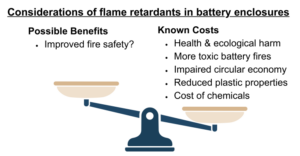 Pros versus Cons The unnecessary use of flame retardants can harm our health and stop the safe recycling of plastic without providing any fire safety benefit. PBDEs have been replaced by other flame retardants. One common replacement is tetrabromobisphenol (TBBPA) along with the synergist antimony trioxide. Both chemicals are classified as probable human carcinogens and can cause birth defects. Furthermore, this provision results in harmful flame retardants being detected in recycled plastic consumer products, such as black plastic spatulas, sushi trays, and soup spoons—as well as the soup! We hope that the CPSC during its decision-making process weighs the costs and benefits associated with flame retardant use in battery enclosures and removes the unnecessary and harmful provision that leads to their use. |
Arlene and the Green Science Policy in the Newsby Rebecca Fuoco  We communicate our science to a wide audience. You can too. Below are recent news articles, blogs, podcasts, newsletters, and more that have featured our Institute’s work and expertise. ● The Guardian broke the story on the EPA’s TBBPA risk assessment, quoting Arlene: “It can get into humans and contribute to cancer and behavioral harm. Infants and toddlers who crawl in the dust and put their hands in their mouths are especially vulnerable.” The Cool Down and Raw Story picked up the story and the same quote. |